
WEBINAR ON DEMAND
99 Personalization Use Cases.
Live with the author.
Recorded Thursday 19 November 2026 · Renato Bonomini with Matteo Fabiano
The author of 99 Personalization Use Cases walks through how the book is organized, then explains three of the 99 and answers three questions from the audience.

Renato Bonomini
VP Sales Engineering, ContentWise

Matteo Fabiano
CMO, ContentWise
3Use cases explained
7Lifecycle stages
99In the book
FreeNo form to watch
If you only focus on engagement, you're leaving out half of the potential use cases, and possibly half the value we can bring to the table.
Renato Bonomini, ContentWise by Moviri
WHAT'S INSIDE
The ultimate collection of video streaming use cases
Seven parts, one per stage of the subscriber lifecycle, plus the foundations that set the language and a playbook that turns the rest into a build order. Every chapter opens with the question a product leader actually asks, and answers it in the first paragraph.
| Part | Stage | The question it answers | The KPI it moves |
|---|---|---|---|
| 01 | Acquisition | How do we convert a non-subscriber? | Cost per acquisition |
| 02 | Onboarding | Does the new user reach value before they doubt? | Time to first value |
| 03 | Conversion | Does the surface turn interest into action? | Conversion to play |
| 04 | Engagement | Do they keep finding things worth watching? | Streaming minutes, take-rate |
| 05 | Satisfaction | Did the experience build trust, or only minutes? | Return frequency, NPS |
| 06 | Monetization | Can we grow value per user without breaking trust? | ARPU, upsell take-rate |
| 07 | Retention | Do we keep the subscribers the product can hold? | Churn, LTV |
Before the seven parts, the foundations: what personalization actually is as distinct from recommendations, why metadata is what makes any of it work, how to place your own service on the maturity curve, and the sequencing that decides what to build first. After them, the implementation playbook, which turns 99 use cases into an order of operations.
ANATOMY OF A USE CASE CARD
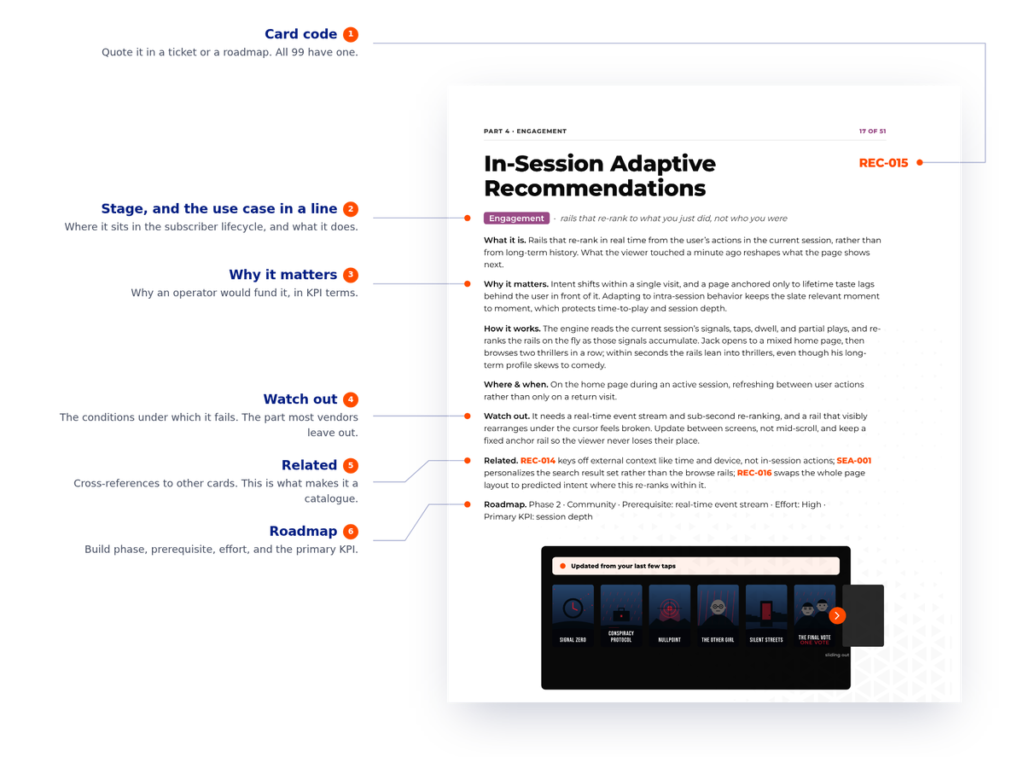
Every use case answers the same six questions
Most lists of personalization features name the feature and stop. Each of the ninety-nine entries tells you where it fits in the subscriber lifecycle, what business case funds it, which KPI it moves, the conditions under which it fails, and what has to exist before you build it.
WHO THIS IS FOR
What this book is, and who it is for
Renato Bonomini
VP Sales Engineering, ContentWise by Moviri
This is the reference I wished existed. Every personalization use case that matters to a streaming operator, organized by where it pays off in the subscriber lifecycle, with real benchmarks and the counter-narratives most vendors will not print.
I wrote it for the leader who already runs personalization and owns the engagement, conversion and retention numbers. It assumes you have a recommender in production, an editorial strategy you can defend, and retention targets someone is measuring you against.
Two choices shaped it. Running the catalogue along the subscriber journey rather than down a feature list forces every use case to answer a question you actually have: who is this for, at what moment, and what number should move. And it prints the use cases that do not work, the ones that lift a click and move nothing that matters, along with the conditions under which the good ones fail.
- Product leaders
- You own the discovery surfaces and answer for engagement.
- Editorial and programming leads
- You decide what gets promoted, to whom, and when.
- Engineering and data leads
- You build the rails and keep them fed with metadata.
- Strategy and commercial leads
- You carry ARPU, churn and LTV.
EBOOK FAQ
What operators want to know
How many personalization use cases are there for a streaming service?
ContentWise catalogued 99, grouped by what the viewer is doing: discovery, search, trust and explanation, and off-platform. Each one is placed at the subscriber lifecycle stage where it pays, with the KPI it moves, the effort it takes, and the build phase it belongs to.
What are the stages of the streaming subscriber lifecycle?
Seven: acquisition, onboarding, conversion, engagement, satisfaction, monetization, and retention. Each stage has its own KPI, and a use case that works in engagement can be the wrong instrument in onboarding.
What is the difference between recommendation, curation, and personalization?
Recommendation is one use case: ranking titles inside a single carousel against a single objective. Personalization adapts the whole experience, page plus search plus collections, to the viewer's journey, device, and context, which means deciding which rails exist and in what order before deciding what goes in them.
Should editorial curation or the algorithm decide what users see?
Neither, exclusively. Every rail carries a dial between hand-picked and machine-ranked: editors define the blocks and priorities, the algorithm fills and ranks them per profile, and the blend covers both failure modes, an algorithm's popularity bias and editorial's inability to scale to thousands of micro-segments.
Why is metadata the thing that decides whether personalization works at all?
Because algorithms only know what the metadata tells them, and bad metadata is the most common reason personalization efforts fail. The book gives a four-metric self-diagnostic you can run this quarter: coverage, distribution, number of values per item, and consistency.
Once content is commoditized, what actually differentiates a streaming operator?
The experience. Most content is ubiquitous and operator catalogs are largely undifferentiated, so the durable differentiator is the experience aligned to where the viewer is in the journey, not the one running the loudest algorithm.
How mature is our personalization, and what comes next?
Maturity runs on two axes: how much you know about the viewer, and how much of the page you act on. The sequencing rule that wins is content first, community second, full UX personalization last, because content-based and statistics rails work on day one with zero behavioral history.
Which personalization use cases lift a click and move nothing that matters?
Click-through and take-rate are local, short-term wins that do not guarantee retention, satisfaction, or monetization. The book names the use cases where that gap appears and the conditions under which the reliable ones fail.
Get the book
All 99 use cases, including the three in the video. One PDF, free.
Planning a new use case?
Bring the use case you are planning. A ContentWise engineer will tell you what it takes to run it in production.
Or download the ebook here.