
EBOOK
99 Personalization Use Cases
What Works, What Doesn’t, and When
Every personalization use case that matters to a streaming operator, mapped on the subscriber lifecycle stage where it belongs and the KPIs it affects.
Written by Renato Bonomini, VP Sales Engineering, ContentWise. Foreword by Paolo Cremonesi, Co-founder and CTO. With Gianluca Leucci, Paolo Romano and Matteo Fabiano.
99Use cases
7Lifecycle stages
225Pages
FreeNo paywall
Twenty-five years ago the hard problem in television was distribution. Today it is attention.
From the foreword by Paolo Cremonesi, Co-founder and CTO, ContentWise by Moviri
WHAT'S INSIDE
The ultimate collection of video streaming use cases
Seven parts, one per stage of the subscriber lifecycle, plus the foundations that set the language and a playbook that turns the rest into a build order. Every chapter opens with the question a product leader actually asks, and answers it in the first paragraph.
| Part | Stage | The question it answers | The KPI it moves |
|---|---|---|---|
| 01 | Acquisition | How do we convert a non-subscriber? | Cost per acquisition |
| 02 | Onboarding | Does the new user reach value before they doubt? | Time to first value |
| 03 | Conversion | Does the surface turn interest into action? | Conversion to play |
| 04 | Engagement | Do they keep finding things worth watching? | Streaming minutes, take-rate |
| 05 | Satisfaction | Did the experience build trust, or only minutes? | Return frequency, NPS |
| 06 | Monetization | Can we grow value per user without breaking trust? | ARPU, upsell take-rate |
| 07 | Retention | Do we keep the subscribers the product can hold? | Churn, LTV |
Before the seven parts, the foundations: what personalization actually is as distinct from recommendations, why metadata is what makes any of it work, how to place your own service on the maturity curve, and the sequencing that decides what to build first. After them, the implementation playbook, which turns 99 use cases into an order of operations.
ANATOMY OF A USE CASE CARD
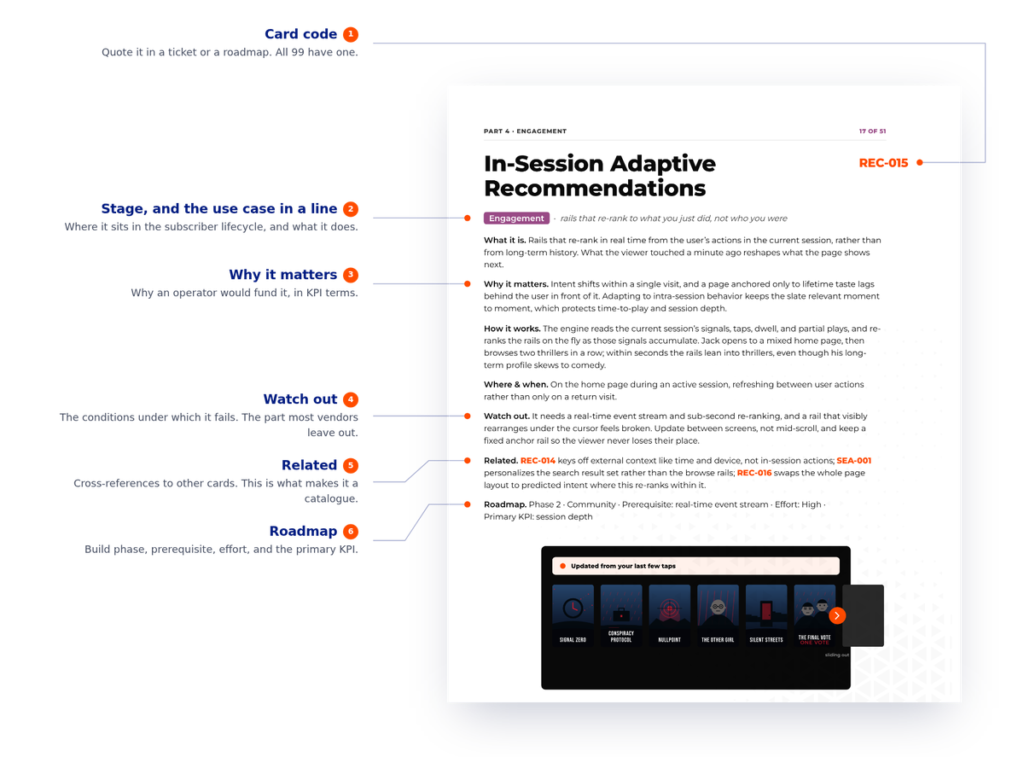
Every use case answers the same six questions
Most lists of personalization features name the feature and stop. Each of the ninety-nine entries tells you where it fits in the subscriber lifecycle, what business case funds it, which KPI it moves, the conditions under which it fails, and what has to exist before you build it.
ALL 99 USE CASES
Which ones are you running?
Nobody had catalogued them, so we did. Once you see all ninety-nine in one place the useful question is not how many you run. It is whether the ones you run map to the correct lifecycle stage, and whether they move your KPIs.
Search
15use casesThe viewer asks. Lean forward, goal-directed.
- SEA-001Personalized Search
- SEA-002Semantic Search
- SEA-003Search by Metadata
- SEA-004Fuzzy Search
- SEA-005Alias-Aware Search
- SEA-006Search Suggestions
- SEA-007Top Searches
- SEA-013Grouped / Multi-Row Search Results
- SEA-008Strategic Search Ranking
- SEA-009Conversational Search & Discovery
- PLY-003EPG-via-Chat
- SEA-010Shadow Catalog (Ghost Search)
- SEA-012Augmented Search (Recommendations-in-Search)
- AGG-002Federated / Cross-Service Search
- LIN-003A-Z Catalog Browse
Discovery
72use casesThe system proposes. Lean backward, and where most personalization earns its keep.
- REC-001Top Picks For You
- REC-007More Like This
- REC-008People Who Enjoyed This Also Enjoyed
- REC-004Dynamic Categories
- REC-005Hidden Gems
- REC-020Visually-Similar Recommendations
- REC-014Contextual Recommendations
- REC-015In-Session Adaptive Recommendations
- REC-017Decision-Budget-Aware Recommendations
- REC-019Play Something / Auto-Play
- REC-021Swipe Feed / Short-Form Infinite Feed
- REC-024Shuffle / Play Random Episode
- MOO-002Mood Selector
- MOO-003Contextual Mood Triggers
- NBA-001Next-Best-Action
- EDT-009Last Chance To Watch
- EDT-001Hero Banner
- EDT-004Algotorial
- EDT-003Editorial Layout
- EDT-002Personalized Promotions
- EDT-014Personalized Upcoming Movies
- EDT-005Thematic Collections
- EDT-006Box Set Collections
- EDT-019Seasonal / Occasion Rails
- PAG-001Page Personalization
- MSG-001Behavioral / Dynamic-Title Messaging Overlay
- EDT-007Recently Added
- EDT-008New Releases
- EDT-010Most Viewed
- EDT-011Trending Now
- EDT-012Most Liked
- EDT-013Highest Critics Score
- EDT-015Trending Entities
- EDT-020Popular in Your Region
- FBK-002Explicit Ratings (Thumbs / Stars)
- SOC-001Social / Friends Recommendations
- PRE-001Personalized Imagery / Artwork
- PRE-002Dynamic Titles
- PRE-003AI Widget Selection
- PRE-004Personalized Preview Autoplay
- REC-016Session-Intent-Adaptive Homepage
- AGG-001Third-Party App Recommendations
- AGG-003Cross-Media Recommendations
- LIN-001Personalized Channel Discovery
- LIN-002Live & Upcoming
- LIN-005Personalized Linear For You Channel
- LIN-004FAST Channel Auto-Generation
- MON-001Top Rental
- MON-002Pack Related
- MON-003Marketing Engine Promotion Packages
- MON-004TVOD / Add-on Upsell Overlay
- PLY-001Preroll Optimization
- CRM-004Win-Back / Churn-Discount Overlay
- CRM-006Cancel-Flow Save Offers
- OB-001New User Onboarding
- OB-002Personalization Post Ad-Click
- MOO-001Mood Board / Taste Profile
- MOO-004Clip-Based Mood Inference
- SPT-001Fandom-Keyed Sport Pages
- SPT-002Live Event Prioritization & Notification
- SPT-003Post-Event Cards
- KID-001Kids / Parental-Control Onboarding
- REC-003Continue Watching
- REC-009Next-To-Watch
- PLY-002In-Player End Cards (Next Episode)
- REC-010Watch Again
- REC-011From Your Watchlist
- REC-012Unwatched in My Stuff
- REC-023Recently Viewed
- DWN-001Smart Downloads / Downloads For You
- RCP-001Personalized Recaps / Catch Up
- RCP-002What You Missed Yesterday
Trust and explanation
5use casesUnderstanding and believing the system, rather than finding content.
- REC-006Because You...
- EDT-016Why This?
- EDT-017Percentage Match Score
- FBK-001Two-Way Feedback Overlay
- REC-018Long-Term Satisfaction Ranking
Off-platform
7use casesReaching the viewer when they are not in the app at all.
- CRM-001Behavioral Trigger Comms & Notifications
- CRM-002Recommendation API into CRM
- CRM-003Propensity-Scored Lifecycle Tracks
- NOT-001Coming Soon / Notify-Me Reminders
- YIR-001Year-in-Review / Your Year
- ACQ-001Cohort & Look-alike Ad Targeting
- SEG-001Audience Segmentation for Campaigns
THE KEY ARGUMENT
Engagement is not loyalty
The systems that lift retention and LTV are the ones that align personalization to where the user is in their journey. Aggression in the algorithm is not the variable. A new user, a trialist, a power viewer, and a subscriber halfway out the door need different things, and the same recommendation row serves none of them well. Every part of this book serves that single thesis.That is the right instinct pointed at the wrong target.
Too many options, not enough guidance, the same friction every night. A good system answers it before the user feels the fatigue. That is the job. This book is about doing it at every stage, not just on the home page.
WHO THIS IS FOR
What this book is, and who it is for
Renato Bonomini
VP Sales Engineering, ContentWise by Moviri
This is the reference I wished existed. Every personalization use case that matters to a streaming operator, organized by where it pays off in the subscriber lifecycle, with real benchmarks and the counter-narratives most vendors will not print.
I wrote it for the leader who already runs personalization and owns the engagement, conversion and retention numbers. It assumes you have a recommender in production, an editorial strategy you can defend, and retention targets someone is measuring you against.
Two choices shaped it. Running the catalogue along the subscriber journey rather than down a feature list forces every use case to answer a question you actually have: who is this for, at what moment, and what number should move. And it prints the use cases that do not work, the ones that lift a click and move nothing that matters, along with the conditions under which the good ones fail.
- Product leaders
- You own the discovery surfaces and answer for engagement.
- Editorial and programming leads
- You decide what gets promoted, to whom, and when.
- Engineering and data leads
- You build the rails and keep them fed with metadata.
- Strategy and commercial leads
- You carry ARPU, churn and LTV.
EBOOK FAQ
What operators want to know
How many personalization use cases are there for a streaming service?
ContentWise catalogued 99, grouped by what the viewer is doing: discovery, search, trust and explanation, and off-platform. Each one is placed at the subscriber lifecycle stage where it pays, with the KPI it moves, the effort it takes, and the build phase it belongs to.
What are the stages of the streaming subscriber lifecycle?
Seven: acquisition, onboarding, conversion, engagement, satisfaction, monetization, and retention. Each stage has its own KPI, and a use case that works in engagement can be the wrong instrument in onboarding.
What is the difference between recommendation, curation, and personalization?
Recommendation is one use case: ranking titles inside a single carousel against a single objective. Personalization adapts the whole experience, page plus search plus collections, to the viewer's journey, device, and context, which means deciding which rails exist and in what order before deciding what goes in them.
Should editorial curation or the algorithm decide what users see?
Neither, exclusively. Every rail carries a dial between hand-picked and machine-ranked: editors define the blocks and priorities, the algorithm fills and ranks them per profile, and the blend covers both failure modes, an algorithm's popularity bias and editorial's inability to scale to thousands of micro-segments.
Why is metadata the thing that decides whether personalization works at all?
Because algorithms only know what the metadata tells them, and bad metadata is the most common reason personalization efforts fail. The book gives a four-metric self-diagnostic you can run this quarter: coverage, distribution, number of values per item, and consistency.
Once content is commoditized, what actually differentiates a streaming operator?
The experience. Most content is ubiquitous and operator catalogs are largely undifferentiated, so the durable differentiator is the experience aligned to where the viewer is in the journey, not the one running the loudest algorithm.
How mature is our personalization, and what comes next?
Maturity runs on two axes: how much you know about the viewer, and how much of the page you act on. The sequencing rule that wins is content first, community second, full UX personalization last, because content-based and statistics rails work on day one with zero behavioral history.
Which personalization use cases lift a click and move nothing that matters?
Click-through and take-rate are local, short-term wins that do not guarantee retention, satisfaction, or monetization. The book names the use cases where that gap appears and the conditions under which the reliable ones fail.
Join us at IBC 2026
We are at IBC in Amsterdam from 11 to 14 September, Hall 5, Stand 5.G50.
[Or email info@contentwise.com]