
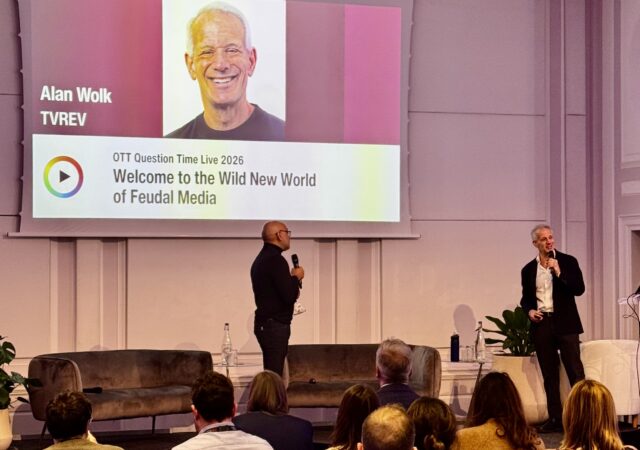
The vibe at 20 Cavendish Square this year was clear: the industry has reached the end of the experimentation cycle.
We are now in the Seventh Major OTT Cycle, one defined by planned, measured, and repeatable growth.
From the two days of candid debates with leaders from the BBC, ITV, Sky, and Amazon, here are the three biggest takeaways for tech and product teams.
We’re facing a discovery crisis. UK viewers spend 11 minutes choosing what to watch; in France, that figure doubles to 22 minutes. As Alan Wolk noted, we are living in an era of feudal fragmentation. The fix isn’t more content, it’s reducing the time-to-glass.
The BBC and others are proving that vertical, scroll-native formats aren't just for TikTok, they are high-signal tools to help viewers sample content and make faster decisions.
Discovery is shifting from "What do you like?" to "How do you feel right now?
In a fragmented market, no one wins in a silo. The “Power of Partnerships” panel made it clear that collaboration is now the default growth model.
Projects like Freely are restoring the flickable live TV experience by aggregating PSB viewing into a single, seamless UX.
Whether it’s bundle deals with Amazon and Sky or the unavoidable role of YouTube in the distribution mix, the goal is to coexist. If your metadata isn’t built for cross-platform syndication, you’re invisible.
This was the most provocative thread of the “AI Afternoon.” While GenAI is a brilliant creative tool for marketing and signature journalism, it often hits a wall in production-level personalization.
As our CTO Paolo Cremonesi argued, 90% of complex AI models fail to move business KPIs because they look great in the lab but break the latency budget or lack transparency in the real world. The takeaway? Don’t replace your recommendation engine with an LLM. Orchestrate them. Use Hybrid Intelligence to pair semantic depth (LLMs) with scalable engineering (RecSys).
Are you building for the hype, or for the Seventh Cycle?
© 2026 ContentWise. All rights reserved.